
10 Best Artificial Rice Processing Lines for Efficient Production
2026-05-26
In the competitive landscape of artificial rice manufacturing, choosing the right processing line can mean the difference between soaring profits and frustrating bottlenecks. To help you navigate the options, we’ve curated a list of the 10 best artificial rice processing lines for efficient production. Among them, solutions from MINGDE stand out for their innovative engineering and reliability. Whether you’re scaling up or starting fresh, this guide will spark your next move toward streamlined success.
How Precision Extrusion Is Redefining Artificial Rice Production
For decades, artificial rice struggled to shake off its reputation for a mealy texture and off-putting flavor. That’s all changing, thanks largely to precision extrusion systems that now allow manufacturers to mimic the exact bite, mouthfeel, and cooking behavior of real grain. By controlling temperature, screw speed, and die geometry down to the micron, these machines can restructure blends of broken rice, starches, and fortificants into kernels that swell and soften in boiling water almost identically to how jasmine or basmati rice would. It’s not just about making filler—it’s about delivering a staple that actually satisfies.
The engineering leap moves beyond the crude, low-moisture extrusion of the past. Newer methods employ twin-screw extruders that introduce precision zones for kneading, degassing, and shaping, allowing for a porous internal structure that hydrates uniformly. This eliminates the dreaded crunchy center or gummy exterior. Operators can dial in the desired starch gelatinization profile, so the finished product stays separate and fluffy instead of clumping into a sticky mass. The result is a product that can hold its own in a pilaf, stir-fry, or simply steamed with a pat of butter—no excuses needed.
Another quiet revolution is in mass customization. With precision extrusion, switching from a vitamin-fortified grain for humanitarian aid to a low-GI version enriched with pulse proteins is no longer a week-long teardown and recalibration. Quick-change dies and recipe memory cut changeover times drastically, while inline sensors monitor color, density, and expansion in real time. This agility means smaller batches can be tailored for niche diets—keto, high-fiber, or allergen-free—without hammering production costs. In short, the tech is transforming artificial rice from a cheap commodity into a versatile, targeted nutrition platform.
The Hidden Energy Savers in Today’s Processing Lines
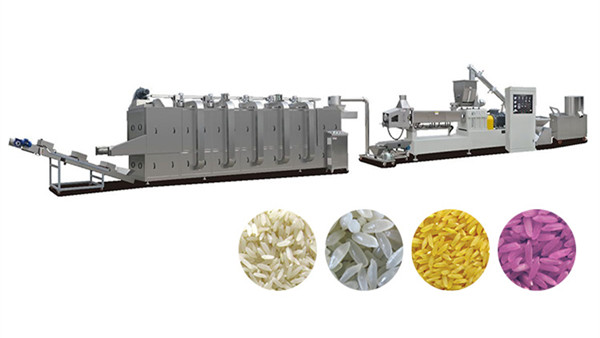
Modern processing lines often harbor subtle yet impactful energy-saving features that go unnoticed. Variable frequency drives on motors, for instance, adjust speed to match actual demand rather than running at full throttle constantly, slashing power consumption without compromising output. Similarly, advanced heat recovery systems capture waste thermal energy from one stage to preheat materials in another, turning what was once lost heat into a valuable resource.
Beyond the headline components, smart sensors and predictive maintenance play a quiet but crucial role. By monitoring equipment conditions in real time, they prevent the energy drain caused by worn belts, clogged filters, or inefficient setups. This data-driven approach keeps the entire line humming at peak efficiency, often reducing energy use by double-digit percentages while extending equipment life.
Even the layout and control philosophy of a line contribute to hidden savings. Minimizing material transfer distances and optimizing buffer capacities cuts the energy spent on conveyors and reduces idle time. When these elements work in concert, the cumulative effect is substantial—delivering a leaner operation where energy frugality is built into the very fabric of the process.
Achieving Grain Perfection: Inside Automated Quality Checks
In the relentless pursuit of flawless grain, automated quality checks have shifted from a luxury to a necessity. Modern mills now deploy a suite of sensors and imaging systems right on the processing line, capturing every kernel's story at a pace no human team could match. High-speed cameras paired with spectral analysis scan for discoloration, cracks, and foreign matter, while shape-recognition algorithms ensure only plump, uniform grains make the cut. This isn't just about catching defects—it's about building a digital fingerprint for every batch, allowing millers to fine-tune settings on the fly and maintain a consistency that once seemed impossible.
What sets today's systems apart is their ability to learn and adapt. Traditional sorters relied on simple thresholds; if a grain was too dark or too small, it was rejected. Now, machine learning models trained on thousands of samples can spot subtle anomalies like chalkiness or stress fractures invisible to the naked eye. The result is a precision that not only elevates visual appeal but also safeguards cooking properties and shelf life. Operators see real-time dashboards that flag deviations, but the machine often corrects itself before a human can intervene, blending ageless craftsmanship with cutting-edge intelligence.
Beyond the lab, these checks resonate in kitchens worldwide. When a family scoops rice that cooks evenly every time, or a brewery sources barley with predictable extract yields, they're tasting the outcome of silos full of sensors and smart decisions. The technology also cuts waste dramatically—catching borderline kernels that can be redirected to secondary uses rather than discarded. It's a quiet revolution, where grains aren't just sorted; they're understood. And that deep understanding is what transforms a staple commodity into a promise of perfection, bin after bin.
Scaling Up or Down: Why Modular Configurations Matter
When systems are built as monolithic blocks, any shift in demand forces a painful choice: overspend on idle capacity or risk collapse under load. Modular architectures sidestep this entirely by letting you treat components like interchangeable units. Instead of redesigning the entire infrastructure when traffic spikes, you simply add more of the bottlenecked module—say, a payment processing node or a caching layer. The rest of the system remains untouched, and the adjustment can be made in hours, not weeks.
This granular control also changes the economics of scaling. Rather than procuring a massive server that might sit half-empty, you deploy smaller, specialized modules that align precisely with actual usage patterns. When a promotional campaign doubles the read requests but leaves write operations steady, you spin up extra read replicas without touching the write master. The result is a resource footprint that breathes with your business—tight during quiet periods, expansive under peak loads—without wasteful overprovisioning.
Beyond raw capacity, modularity fosters resilience during scaling events. Because each module operates within well-defined boundaries, failures stay contained. A memory leak in a report generation service won’t cascade into the user authentication layer. Hot-swapping enables maintenance or upgrades on one module while others continue serving traffic, turning what used to be a downtime nightmare into a transparent, live operation. This isolation turns scaling from a brittle, all-or-nothing gamble into a confident, incremental process.
Built to Last: Lines That Handle Continuous Run Demands
Not every production line is built for the long haul. Some start strong but buckle under the relentless pace of 24/7 operation. The difference lies in the details: reinforced drive components, precision-machined wear surfaces, and cooling systems that don't quit. When a line is designed from the ground up to absorb constant stress, maintenance windows shrink and output stays predictable. It's not about surviving a single shift—it's about delivering the same throughput on day 800 as on day one.
Continuous operation exposes weaknesses that intermittent runs never reveal. Bearings that seize, controls that drift, conveyors that slip—these aren't signs of bad luck, they're symptoms of design compromises. Manufacturers serious about uptime obsess over thermal stability, material fatigue curves, and redundant pathways that let repairs happen without hitting the emergency stop. The result is a line that treats unplanned downtime as a design defect, not an inevitability.
What separates a workhorse from a liability is often invisible during the first month. It's the oversized gearbox that never strains, the modular frame that dampens vibration instead of amplifying it, the self-monitoring sensors that catch misalignment before it becomes a breakdown. When the demand is nonstop, the line has to be more than tough—it needs to be forgiving of the real-world variables that wear down lesser setups. That kind of resilience can't be retrofitted; it has to be engineered in from the start.
Real-Time Tweaks: The Role of Smart Control Systems
Modern industrial systems rarely operate at a fixed setting for long. Variables like temperature, pressure, or load shift constantly, and clinging to a static configuration wastes energy and wears down equipment. Smart control systems step in here, reading sensor data and making split-second adjustments that keep everything within an optimal band—not just reacting to problems, but anticipating them.
Behind the scenes, these controllers lean on feedback loops that compare actual performance against desired targets. If a motor draws more current than expected, for example, the system might ease the load or tweak the voltage on the fly. Some setups even learn from historical patterns, using that insight to refine their responses over time without anyone touching the settings manually.
The payoff goes beyond smoother operation. By constantly fine-tuning processes, plants cut down on electricity bills, extend machine life, and reduce surprises that lead to downtime. Operators also get a clearer view of what's happening, as the control logic surfaces anomalies that might otherwise go unnoticed until something breaks.
FAQ
It's a complete set of machinery that turns raw ingredients like broken rice, flour, or starches into nutritionally fortified rice grains. The process typically involves mixing, extruding, cutting, and drying to create a product that mimics natural rice in texture and appearance.
Start by evaluating your target output volume, available space, and budget. Look for lines that offer flexibility in raw material use, easy scalability, and proven reliability. Visiting existing setups or requesting sample runs can help you judge the grain quality and consistency.
Efficiency boils down to a few things: a precise extrusion system that minimizes waste, energy-saving drying technology, automated controls for uniform shaping, and quick changeover parts for different rice shapes. Also, stainless steel construction and easy cleaning reduce downtime and maintenance costs.
Some well-regarded names include Bühler, Jinan Saibainuo, and Wenger Manufacturing. They offer a range of lines from small-scale to industrial models, each with distinct strengths in extrusion technology, after-sales support, and customization options.
Capacities vary widely. Small units might produce 100-150 kg per hour, while medium lines deliver 300-500 kg/h. Large industrial setups can exceed 1,000 kg/h. The actual output depends on the raw material recipe, grain shape, and drying efficiency.
Yes, that's one of its main advantages. You can blend in vitamins, minerals, and even fiber during the mixing stage. The extrusion process helps bind these nutrients, so the final product retains them through cooking. This makes it popular for food fortification programs.
A small line can fit in roughly 50 square meters, with standard three-phase power and a water supply. Larger systems obviously need more space and may require steam boilers or cooling towers. Always check with the supplier for detailed site preparation requirements.
From order to production, count on 2 to 4 months including shipping, installation, and training. Some manufacturers offer turnkey projects where they handle the entire setup and even initial trial runs. Having your site ready with utilities in place speeds things up significantly.
Conclusion
The landscape of artificial rice manufacturing has been transformed by precision extrusion systems that consistently produce grains with the exact texture, shape, and nutritional profile required for today's markets. Unlike older methods that struggled with uniformity, modern lines use advanced screw configurations and temperature controls to replicate the mouthfeel of natural rice while enabling fortification with vitamins and proteins. Integrated automated quality checks now scan every batch—using optical sorters and moisture sensors—to catch imperfections in real time, ensuring that only grains meeting strict specifications move forward. This level of scrutiny was once unthinkable without human inspectors, but now it's standard on the best processing lines. Moreover, the shift toward modular configurations lets producers scale operations without replacing entire systems; they can add polishing units, drying stages, or packaging modules as demand grows, making it a future-proof investment.
Energy efficiency has become a decisive factor in equipment selection, and today's top lines hide impressive power-saving features—from variable frequency drives that adapt motor speeds to load conditions to heat recovery systems that reuse thermal energy from dryers. These tweaks slash operational costs without compromising throughput. For factories running 24/7, robust construction with hardened components handles continuous operation with minimal wear, drastically reducing maintenance windows. Behind the scenes, smart control systems bring everything together, pulling data from sensors across the line and automatically adjusting parameters like water injection rates or cooking temperatures. Operators can oversee the whole process from a single interface, responding to shifts in raw material quality instantly. The result is a harmonious blend of resilience and intelligence that defines efficient artificial rice production today.
Contact Us
Contact Person: LILY SUN
Email: [email protected]
Tel/WhatsApp: 0086-13969103791
Website: https://www.snackfoodmachinery.com/